There is a moment that happens in almost every beginner agility class. A new handler watches a video of some beautifully executed serpentine or German Turn; their eyes go wide, and you can see exactly what they are thinking. I want to do that.
It is completely understandable. Advanced handling looks amazing. It is flowing and fast and it looks like pure teamwork. Of course people want it.
But here is the problem: the handlers in those videos did not start there. And neither did their dogs.
What you are watching is the result of hundreds of hours spent doing things that are far less exciting to film. Forward focus. Simple sends. One jump, then two. Learning to commit to an obstacle and stay committed even when the handler is already moving on. None of that is flashy. Very little of it ends up on Instagram. But without it, the fancy stuff does not work, and more importantly, your dog does not feel good doing agility.
That matters more than people realise.
What your dog actually needs first
When a dog starts agility, they are not just learning where to put their feet. They are learning an entirely new language. They are learning to read your movement, to trust that when you send them to an obstacle you will not disappear, to understand that a tunnel has an exit and it leads somewhere good, to believe that taking the thing in front of them is always the right call.
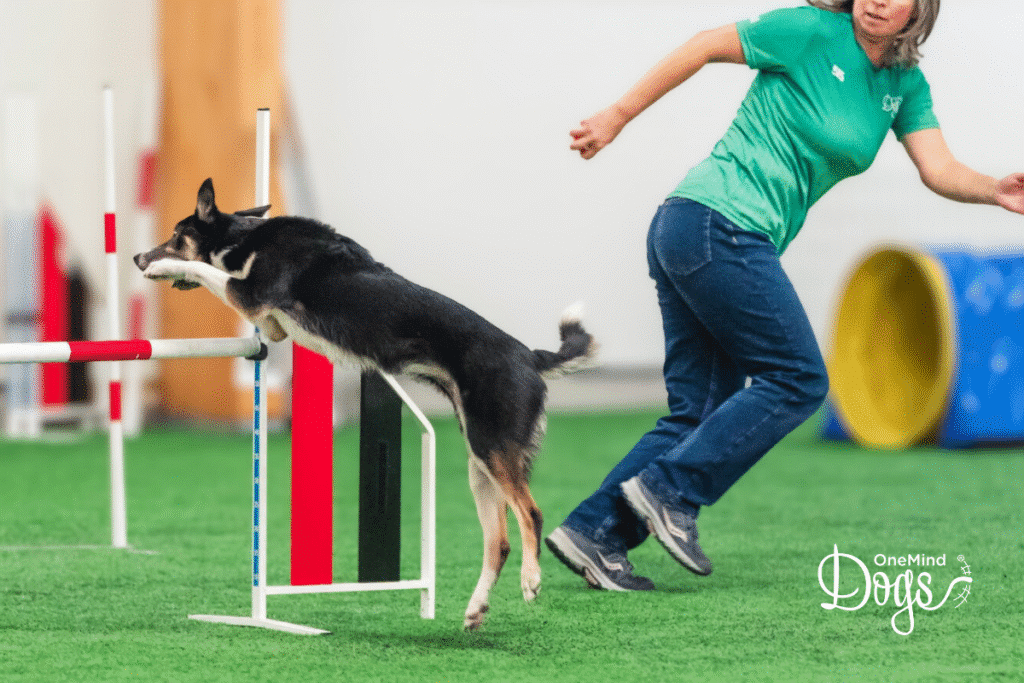
That last one, obstacle focus and the value of taking what is directly ahead, is the whole game at novice level. A dog who confidently takes the obstacle in front of them and trusts their handler to sort out what comes next is a dog who can actually be handled. A dog who is second-guessing every obstacle, who has learned to look back for confirmation before committing, who is not sure whether the tunnel counts or whether they should skip it and come back to you instead, that dog is going to struggle no matter how many handling techniques you layer on top.
Forward focus and commitment are not boring prerequisites. They are the thing that makes agility actually work from the dog’s perspective.
When a dog has real obstacle value and genuine forward drive, they are not stressed. They know their job. They are not scanning for information they do not yet have. They are just running, taking obstacles, having a great time. That is a happy dog. And a happy dog is a dog who wants to play this game with you again tomorrow. Once you have that, bringing in more nuanced handling and handler focus is easy down the track.
Why beginners get overwhelmed (and how this connects)
One of the most common things new handlers say is that they feel overwhelmed. There is too much to learn, too many techniques, too many videos, too many things being explained at once. They do not know where to start so they try to learn everything simultaneously, and they end up feeling like they are failing at all of it.
Here is the honest reason that happens: when you try to apply advanced handling to a dog who has not built the foundational understanding yet, nothing works cleanly. The dog does not commit to the obstacle so the front cross is always a fraction late. The dog curves off the line because they have learned to watch you instead of the course, so your cues become reactive rather than proactive. You spend the whole run trying to manage what the dog is doing in real time rather than trusting what you have built in training.
That is exhausting. And it is not a technique problem. It is a foundation problem.
When you go back and build the basics properly, handling starts to make sense. Your movement does what it is supposed to do. Your dog reads your cues early because they are already committed to the obstacle and have mental space to notice where you are going. The connection between what you do with your body and what your dog does on course becomes clear and logical.
The handlers who find agility genuinely enjoyable, who look calm and connected on course, are not the ones who learned the most techniques. They are the ones who have built dogs that understand the game.
This is why we encourage all students to start with our Foundation for Agility program with their dogs first, even if they’ve already been running sequences.
What novice courses are actually for
Novice sequences are not just easy versions of hard courses. They are specifically designed for what dogs and handlers need to learn first: reading lines, committing to obstacles, maintaining forward motion, and learning to work together without either party panicking.
A clean novice run requires everything. Obstacle focus. Commitment. Connection. Timely cues. Good lines. The fact that the course is shorter and the lines are simpler does not make it easier to do well; it just reduces the number of places where you can go wrong at once, which means you can actually learn from what happens.
This is exactly where new handlers should be putting their energy. Not to get through the novice handling quickly so they can move on to harder things, but to do novice well. To get to the point where a straightforward sequence feels smooth, clear and fun for both of you. Because that feeling – when it clicks, when the dog is running confidently, you’re moving proactively and it all just flows – that is the feeling that keeps people in agility for the rest of their lives.
You cannot shortcut your way to that feeling by learning advanced techniques early. You have to earn it in the basics.
You have more time than you think
Here is something nobody tells beginners often enough: you have years.
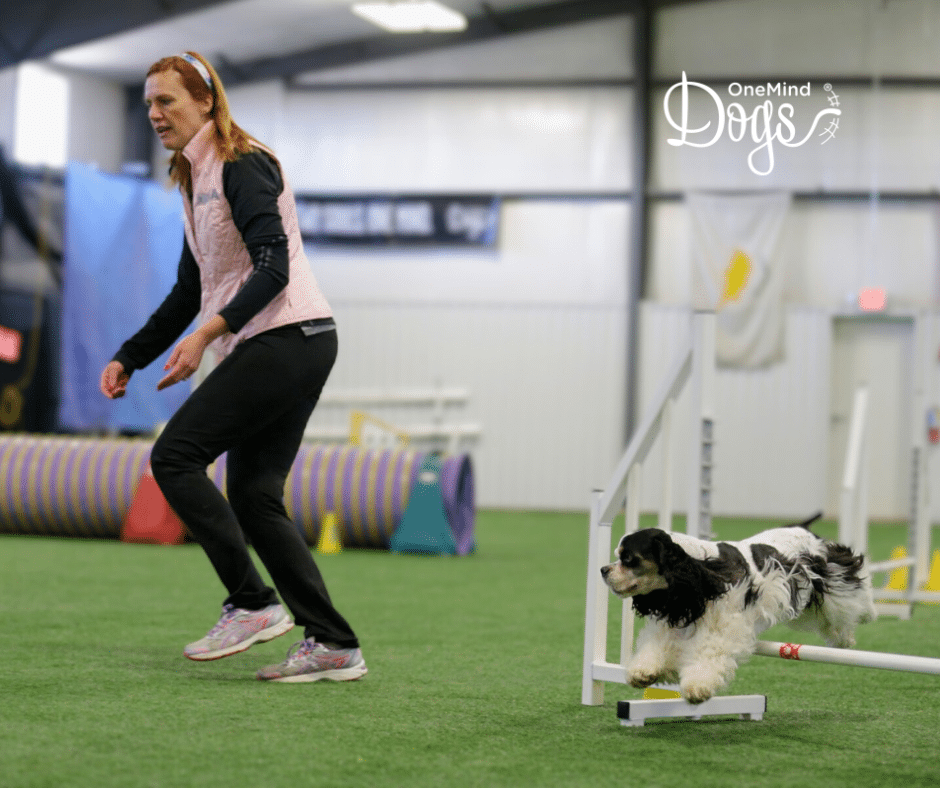
Agility is not a sprint. Your dog has a long training life ahead. The team you build together in the first year or two will shape how you run and compete for everything that comes after. Rushing that foundation does not save time, it creates problems you will spend the next few years trying to fix.
Some of the most skilled handlers in the sport spent a long time doing simple things with careful attention. They did not get bored doing it because they understood what they were building. Every clean send to a single jump was information. Every committed tunnel entry was proof that the dog understood the job. Every smooth, low-pressure training session was a deposit in the account that would pay out later when the courses got harder.
The teams who struggle in competition are almost never the ones who spent too long on foundations. They are the ones who moved on before the foundations were solid.
What to focus on instead
If you are a newer handler and you feel pulled toward all the advanced content, here is a simpler way to think about where to put your attention.
Can your dog take the obstacle in front of them confidently, without checking back, even when you are already moving to the next position? That is commitment, and it is the thing worth training obsessively right now.
Does your dog understand the concept of forward focus, that running ahead and taking what is there is the game? Work on that relentlessly. It will never stop being useful.
Can you do a simple three or four obstacle sequence and have it feel clear and connected for both of you? Do that until it is consistent. Then change the sequence. Then change it again.
Train in short sessions. Keep your dog wanting more. Keep it successful more often than it is not. Let the dog feel good about agility, because a dog who loves agility is the foundation everything else is built on.
The handling techniques will make sense when the time comes. The courses will get more complex when you and your dog are ready for them. But none of that matters if your dog does not love running, does not commit confidently, does not feel clear about their job.
Build that first. Everything else will follow, and when it does, it will be so much easier than you imagined.
One last thought
Every advanced handler you watch and admire had a first year. Most of them had a first year that looked a lot like yours. The ones who became genuinely great at this did not get there by skipping the boring stuff. They got there by taking time to enjoy in the basics, by getting good at simple things before they chased complex ones, and by letting their dogs become confident before they asked them to run complex courses.
That is available to you too. But it starts with letting go of the idea that you need to be somewhere further along than you are right now.
You are exactly where you need to be. Trust the basics, have fun with your dog, and let the rest come in time.
Not sure what you and your dog should be working on right now? With Agility Premium, you can work directly with our coaching team to build a training plan that is right for where you are, so you are not guessing, not overwhelmed, and not skipping ahead of your dog. Start your free trial here >