Are you worried that your new puppy has separation anxiety? Nearly every new puppy owner goes through a stretch of worrying about this. You leave the room for two minutes and come back to frantic barking. Or you head out for a walk without your puppy and it sounds like the end of the world from the other side of the door. You might be wondering whether this is just an adjustment period or something more serious.
The honest answer is that in most cases it is just normal adjustment. And only a smaller portion is true separation anxiety. Both deserve attention, but they need different responses.
What normal adjustment looks like
Your puppy has likely never really been alone before. In the litter there was always another body nearby. Then suddenly there’s a house, a family, and moments where everyone disappears. Some protest at that change is expected. Normal adjustment usually looks like whining or barking that starts when you leave and settles within a reasonably short time,. Behaviour that improves gradually over days and weeks as your puppy builds confidence in being alone, and a puppy who’s otherwise happy, eating normally, and not causing themselves harm.
What points toward separation anxiety
True separation anxiety is less common than the internet sometimes makes it sound. But it does happen, and it’s worth knowing the signs. Panic that doesn’t settle at all during the time you’re gone. Attempts to escape that risk injury, such as chewing through a crate door or scratching at exits until paws bleed. Distress that happens even when you’re just in another room, not only when you leave the house. And little to no improvement, or things getting worse, despite consistent gradual practice over several weeks.
If you’re seeing this list rather than the first one, it’s worth talking to your vet or a qualified trainer. Because separation anxiety usually needs a more structured behavioural plan than general alone time training.
Building alone time gradually
For the majority of puppies dealing with normal adjustment, patience and small steps go a long way.
Start smaller than feels necessary. Step out of the room for a few seconds while your puppy is settled, then come back before any fuss starts. Build the time up slowly, minutes rather than hours, and avoid making a big event out of leaving or returning. The quieter you can make both, the less reason your puppy has to see them as significant.
Giving your puppy something to do while you’re gone, a stuffed chew or a food puzzle, can also help shift the association with alone time from empty and worrying to something worth settling into.
Most puppies improve steadily over the first few months. Especially once they’ve had consistent, calm practice being alone in short stretches rather than being left to figure it out in one big jump.
Where to go from here
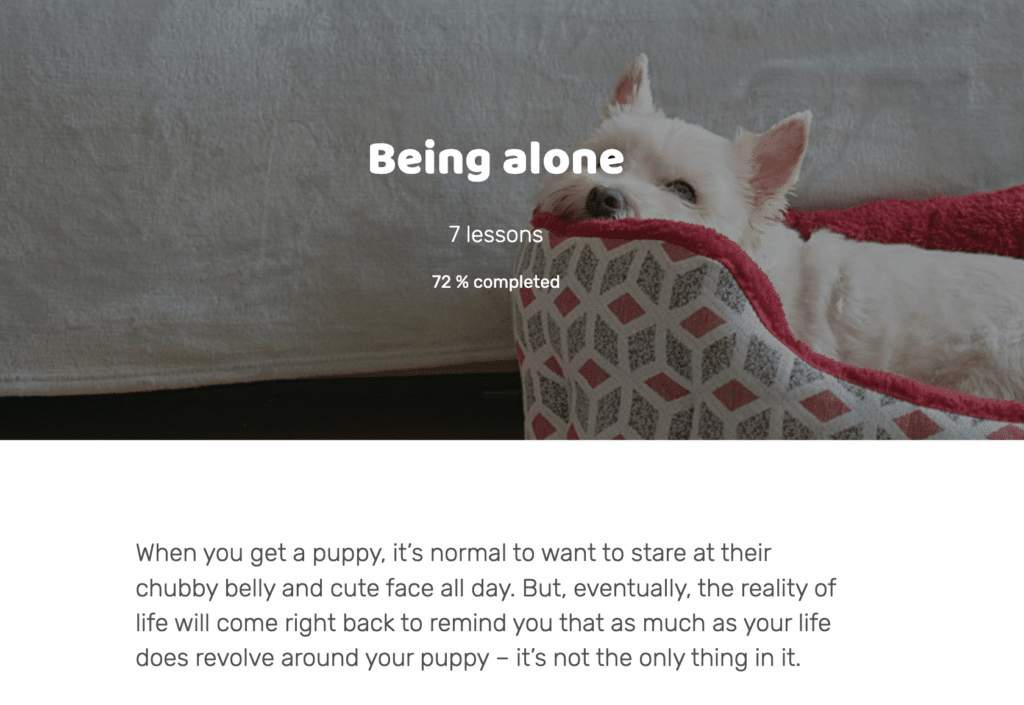
Our Puppy Training program includes a full learning theme dedicated to helping puppies feel comfortable being alone. Built step by step so you’re not guessing what to try next.
Start the full Puppy Training program FREE for 6 months: Train with us for free
If you’re also curious what else you can do to tire out your puppy’s body and mind before you head out the door, our free 10 Day Dog’s Perspective Agility Challenge is a fun way to start exploring agility together at home, no equipment needed and puppies can join in at any age!
Join the free challenge: Start the Dog’s Perspective Agility Challenge