There’s a post you see in agility groups fairly regularly. It goes something like: “My dog is amazing in training, super fast and keen, but the moment we get to a proper course he just switches off around halfway through. Is this a confidence issue? Is he not ready? Should I go back to basics?”
The responses usually go in a few different directions — check his health, maybe he’s stressed, maybe the environment is too much, maybe try more positive reinforcement. All reasonable things to consider. But there’s one possibility that doesn’t come up as often as it should: the dog was never actually trained to work through a full course before getting a reward.
It sounds almost too simple. But this is genuinely one of the most common reasons young dogs start strong and fade somewhere around obstacle 8 or 9. And once you understand why, the fix becomes pretty obvious.
The backyard dog versus the trial dog
Most handlers in this situation have put in a lot of work. The training sessions at home look great. The dog is fast, keen, reads the handling, hits the contacts, does the weaves. You watch your training videos back and genuinely think, right, we’ve got this.
Then you get to a trial and somewhere in the middle of the course the dog checks out. Takes an off-course, starts sniffing, loses the line, or just seems to be running around rather than running with you. And you’re standing there thinking — where did that dog go?
What’s usually happening is that the dog has learned agility in one very specific context, with one very specific reinforcement pattern, and the trial environment is so far outside that context that they don’t quite know what they’re doing there yet. That’s not a confidence problem, and it’s not a distraction problem in the way most people mean it. It’s more that the picture the dog is used to looks completely different from the picture they’re now standing in.
The reinforcement history piece that often gets missed
When you’re building foundation and early skills with a young dog, you reward a lot. Short sequences, quick rewards, high rate of reinforcement. That’s exactly right — it’s how dogs learn fastest and it keeps them keen and engaged.
But over weeks and months of training this way, the dog quietly builds up a very clear picture of what agility looks like: do a handful of obstacles, something good happens, go again. If your dog has mostly worked in sequences of 4 to 6 obstacles before being rewarded, that’s just how agility works in their world.
So when you ask for a full course — 15 or 16 obstacles — before anything happens, you’re not just asking them to run further. You’re asking them to operate in a completely unfamiliar pattern. Somewhere around obstacle 7 or 8, the reward hasn’t arrived when they expected it, and the dog starts doing what dogs do when things feel unclear. They look around, sniff or disengage.
This is even more pronounced at trials, where the environment is novel, you’re nervous, and nothing about the experience matches what training at home feels like.
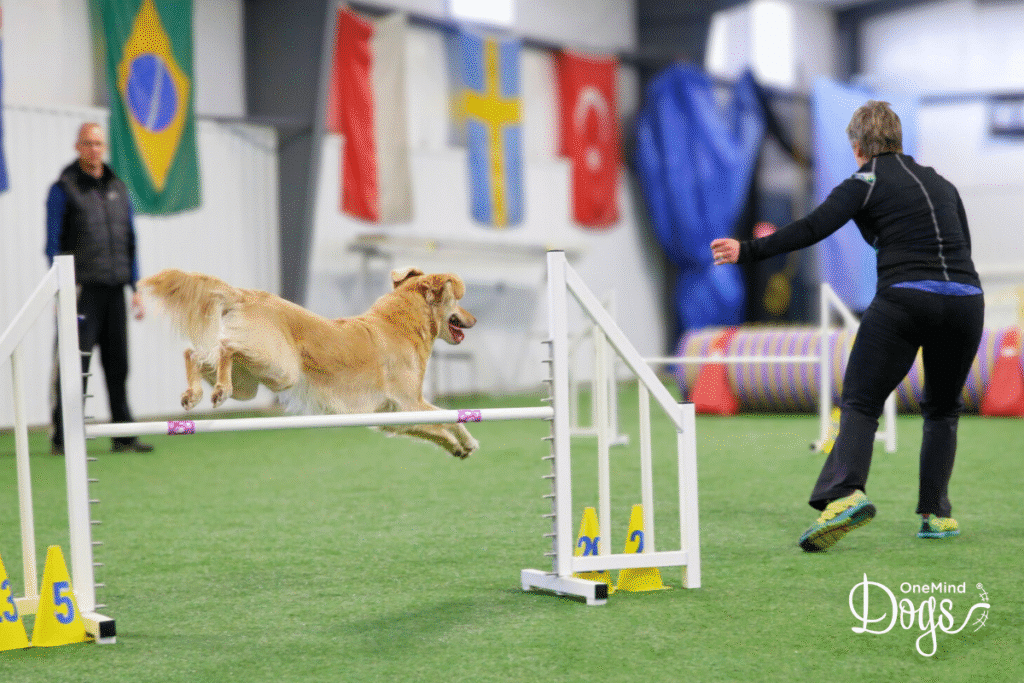
And then there’s the startline
A lot of handlers notice their dog actually moves better without a startline stay — just releasing them and going. There’s a reason for that. The startline at a trial is surrounded by novelty: strange smells, a different surface, someone taking your lead, the lead coming off in an unfamiliar spot, a crowd nearby. If the dog hasn’t had hundreds of repetitions of that exact routine in training, it’s a lot to process before obstacle one even happens.
The startline stay isn’t just an obedience exercise. It’s a skill that needs to be trained in context, including all the bits around it — the lead coming off, the wait, the release, the lead going back on at the end. If that whole sequence only ever happens at trials, it stays novel. And novel is hard when you’re also asking for focus across a full course.
What to actually do about it
The main thing to work on is gradually extending how many obstacles your dog works through before getting a reward, building up to course length over several weeks. Not jumping from 6 to 15 in one session — that’s the same problem again — but taking it step by step so the dog builds a new pattern: sustained effort across a long sequence leads to something great.
Start at whatever length feels easy and solid for your dog right now. Maybe that’s 5 obstacles, maybe it’s 8. Reward there for a few sessions until it feels completely routine, then add one or two more. Keep going until a full course feels just as normal as a backyard sequence.
The sequences in these sessions should be things your dog already knows really well. Tunnels they love, lines they’re confident with, contacts they’ve got solid. The point of this session isn’t to train a skill — it’s purely to train the experience of working through a lot of obstacles and getting rewarded at the end. If you throw in technical challenges at the same time, you’re mixing two different goals and the picture gets muddier.
Once or twice a week, keep doing your normal skill work with lots of rewards. The course-length focus session is something different, maybe once every week or two, sitting alongside everything else.
Use those sessions to rehearse the ring too
When you’re running these longer focus sessions, practise the whole ring routine as well. Lead on, walk in, lead off, startline stay, run the course, lead back on, reward. Every time. Not just the obstacles — the whole thing, in order, the same way it happens at a trial.
The more repetitions your dog has of that full sequence in a low-pressure environment, the less novel it is when the pressure is real. You’re essentially teaching the ring routine as its own skill, which it is.
If your dog genuinely does better without a startline stay right now, that’s fine, train without one while you’re building the other pieces, and come back to it separately when you’ve got more tools in place. Don’t let the startline become a source of stress for both of you before the run even starts.
The environment gap
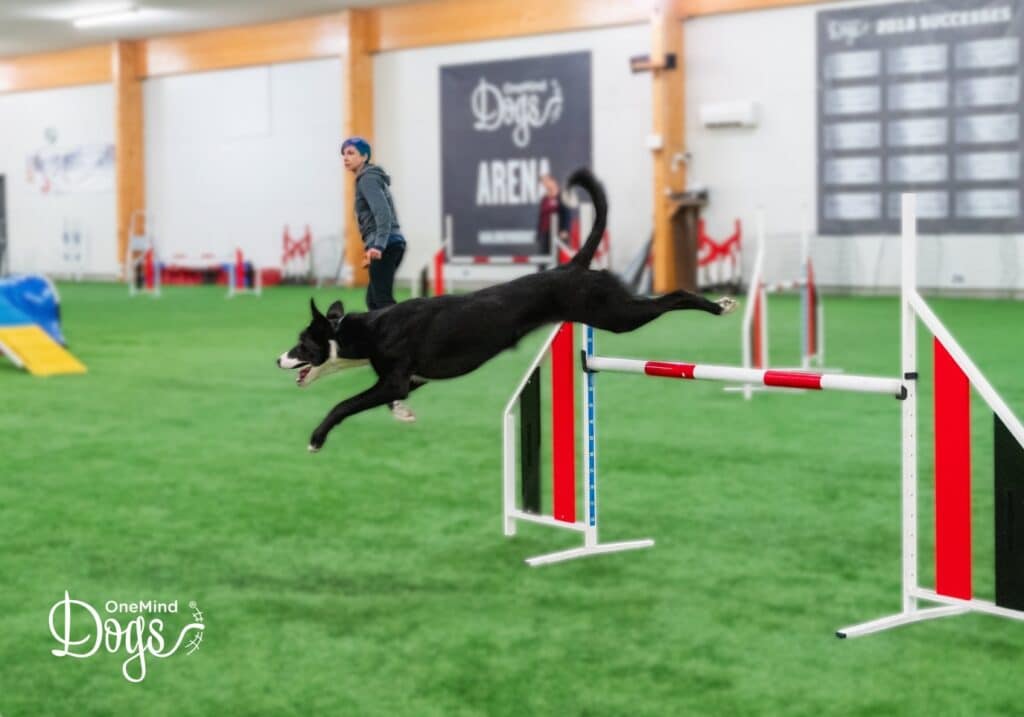
Even once the reinforcement history is sorted, trialling in a new environment will still ask more of your dog than training at home. That part doesn’t fully go away, but it does get smaller the more varied your training environments are.
If you can train somewhere other than your backyard occasionally, a friend’s property, a club on a quiet evening, anywhere with slightly different smells and sounds, that alone starts to teach the dog that agility happens in lots of places, not just one familiar one. You don’t need full trial simulations. Just enough variety that the dog’s picture of agility isn’t locked to a single context.
You’re not starting from zero
If your dog is enthusiastic, driven, and capable at home, you haven’t done anything wrong. You’ve built real skills. What you’re dealing with is a specific preparation gap, not a training failure. The dog you have at home is the dog you’re going to get at trials, it just takes some deliberate work to bridge those two environments.
The handlers who seem calm and in control at trials aren’t necessarily more talented. They’ve usually just done a lot of reps of the exact thing that feels hard right now. That’s trainable. It just takes time.
Getting eyes on your training
The tricky part of working through this is knowing exactly where your dog’s gaps are, which pieces to prioritise, and whether what you’re seeing at trials has one cause or several. Sometimes it’s the reinforcement history piece, or the startline routine is creating tension before the run even starts. Or maybe there’s a handling clarity issue that only shows up with distractions. Often it’s a combination.
Having a coach look at your actual training videos, not just describing the problem, but seeing what’s happening, makes a significant difference in figuring out where to focus first. With Agility Premium, you can submit videos and get specific, personalised feedback on what your dog is seeing and what to work on next. If you’re feeling overwhelmed about where to even start, that’s exactly what the coaching is there for.
Start a free 30-day trial of Agility Premium and get a coach’s eyes on your training >
Happy training,
The OneMind Dogs Team