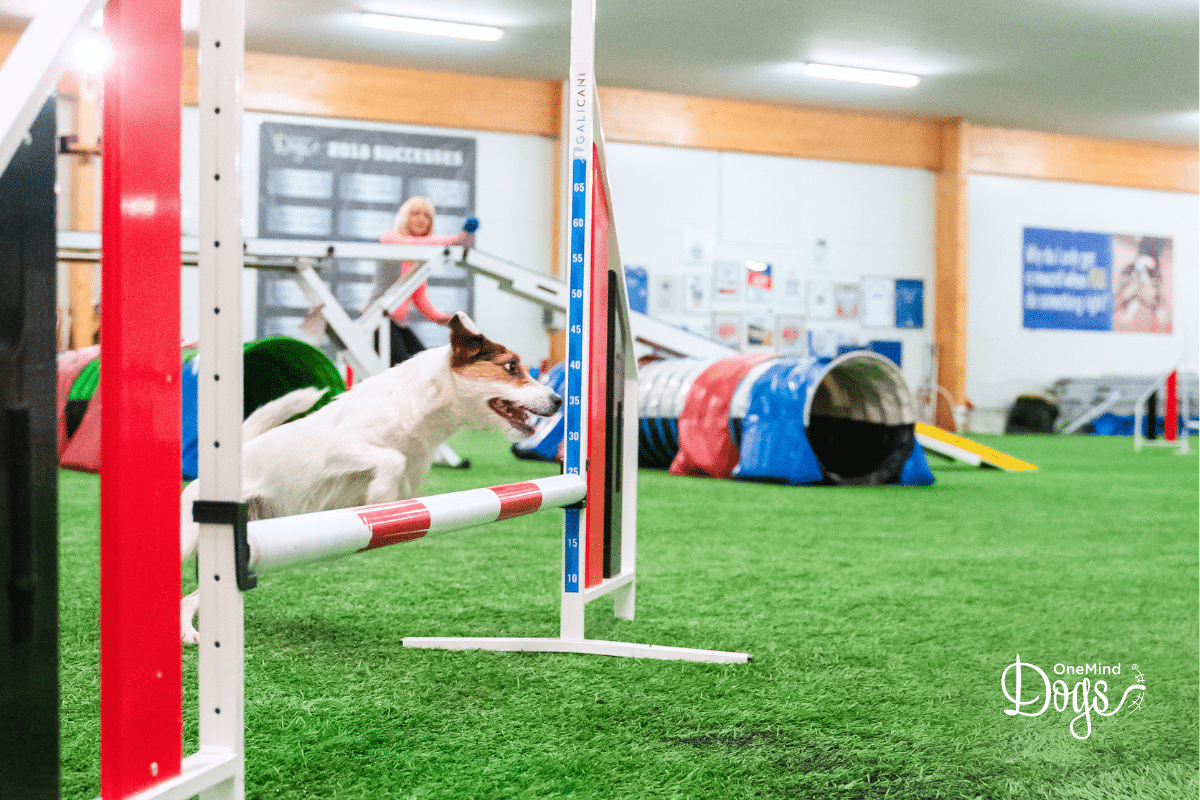
Agility handlers often assume that cueing turns accurately at a distance is just too hard, or that it only works if you are fast enough to stay close to your dog. OneMind Dogs instructor Stephanie Williams has just created a webinar on exactly this topic, and one of the first things she does is tackle some of the assumptions that stop handlers from even trying.
The short version: your dog is already reading far more from you than most people realise.
The myth that trips up most handlers
A lot of handlers assume their dog cannot see them once the dog is out in front. It feels logical, because you are behind them and they are looking at the obstacle. The reality is that dogs have roughly 270 degrees of vision. The only time your dog genuinely cannot see you on course is when they are inside a tunnel. The rest of the time, even when you feel far away or out of position, your dog is still picking up information from you.
Dogs’ rules: your dog runs a parallel line to yours
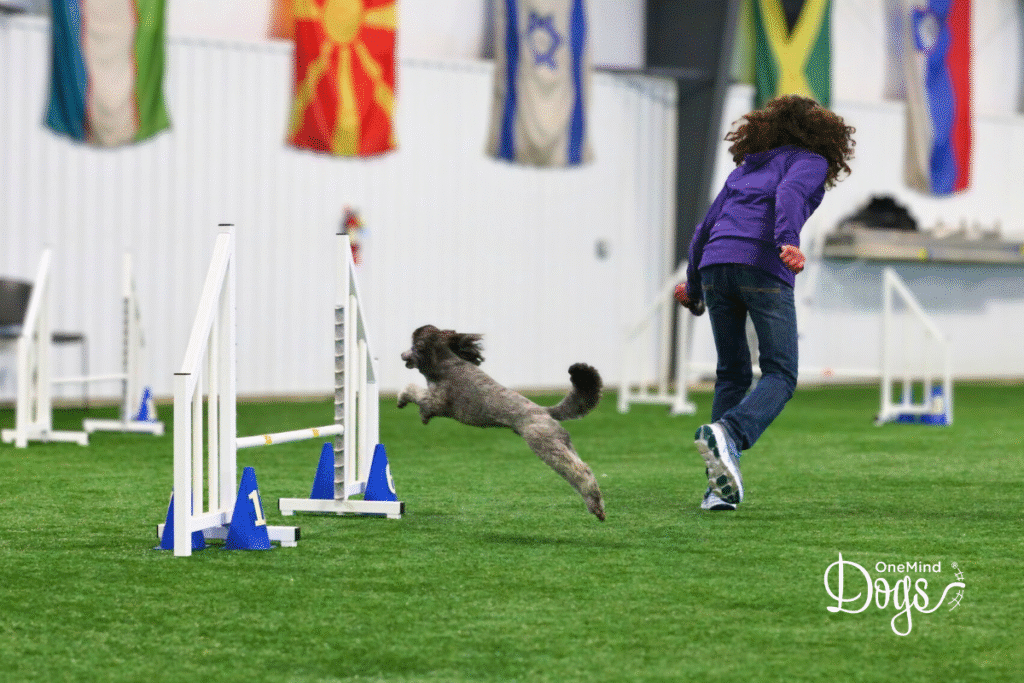
This is one of the things we learned from observing hundreds of dogs during our training sessions over the years, and it is one of our most important dogs’ rules. Dogs naturally run a path that is parallel to the handler’s path. The line you take, even from a distance, is still setting the line your dog takes. Your position on the field matters just as much when you are metres away as it does when you are right beside them. Once you start watching runs with this in mind, you will probably start to see it everywhere, including in your own.
What your speed communicates to your dog
When you speed up, your dog tends to go faster, drive further forward, and work further away from you. When you slow down, your dog slows down, collects their stride, and comes back in towards you. These are real, usable tools for controlling your dog’s line and turn, and they work whether you are physically close to your dog or not. It doesn’t mean you have to run fast, just that you need to use changes in your speed effectively. Even at a walking pace you can show changes in your movement. A well-timed slow down from a moderate pace gives your dog the same information as a slow down from a full sprint.
Timing matters more than distance
Any handling cue needs to happen at least a stride before your dog’s take-off point. This gives your dog time to react and adjust before leaving the ground, whether that means collecting for a tight turn or driving forward for a wider line. When the cue comes too late, your dog physically cannot respond to it, and that is usually when turns fall apart or bars come down.
Getting to know your dog’s stride length and where their natural lines will be makes timing much easier. It is something you can start paying attention to even before you do any specific distance training.
What walking agility teaches you
One of the learning themes inside Agility Premium is Distance handling with Janita, where all the handlers actually walk the courses rather than run them. It sounds counterintuitive, but it turns out to be one of the most useful things a handler can do. When you are not running to compensate for gaps in your handling, you very quickly see what is actually working and what is not. Plenty of our members have described it as a real eye-opener, because they discovered how much their dog could already do independently when given clear information early enough.
It also means that handlers who cannot run at full speed are not disadvantaged. Distance handling done well is not about being fast. It is about being clear.
This matters even if you are not planning big distance sequences
You do not need to be training large-scale distance work for any of this to be useful. Understanding how your dog reads your path and pace makes you a clearer handler in general, because you start to see why your dog went where they did rather than just being surprised by it. That tends to make agility feel a lot more manageable and a lot more fun.
Where to go from here
Stephanie’s full webinar covers this in more detail, including how to read your own dog’s responses, how to build solid foundations for distance work, cue turns from far away and how to troubleshoot when things are not going as expected.
The webinar is part of Agility Premium, which is not a course with a start and end date. It is an ongoing support system for wherever you and your dog are right now in your agility training. With 700+ lessons, guided courses, the Distance handling with Janita learning theme, and personal coaching feedback on your own videos, you always have somewhere clear to go next.
You can register to watch Stephanie’s webinar here: https://www.oneminddogs.com/agility-premium-webinar-cueing-turns-at-a-distance-agility
Happy training, The OneMind Dogs Team