You’re mid-run. Everything feels right. You give the cue you’ve given a hundred times before, and then your dog turns the wrong way. Or runs straight past the jump you were sure they’d take. You replay it in your head afterwards and can’t figure out what went wrong.
If this sounds familiar, you are not alone. And more importantly, your dog isn’t being difficult, stubborn, or “not listening.” They’re confused because something in the information you gave them didn’t add up. Once you understand what’s actually happening from your dog’s point of view, this is one of the most fixable problems in agility.
It’s rarely about disobedience
Most handlers were taught to think about training in terms of obedience. The dog either listens or doesn’t. But agility isn’t obedience; it’s real-time communication happening at speed, and dogs are reading far more of you than most handlers realise.
Your dog is picking up on your movement, your position, where your eyes go, your chest, your feet, your hands, and your voice, all at once, every single run. That’s seven different channels of information firing simultaneously. When all seven agree, your dog gets one clear, unmistakable picture and commits with confidence. When even one or two of them disagree with the rest, and your dog does something different than you expected, that’s not them being defiant. They’re doing exactly what dogs do naturally, which is trust movement and body language over words.
This is why a dog can “know” a skill perfectly in training and still fall apart on course. It’s rarely that they forgot the skill. It’s that the picture you gave them in the moment didn’t match what they were trained to expect.
Why your dog trusts your body more than your voice
Dogs are, by nature, incredibly skilled at reading motion and position. Long before they understand words, they understand where a body is going and what it’s about to do. It’s how they read each other, and it’s how they read us, whether we mean to be sending a signal or not.
So when a handler says “left” but their shoulders, feet, and eyes are still pointing straight ahead, the dog isn’t being asked to choose between “the cue” and “the wrong option.” They’re being handed two different instructions at once, a verbal one and a physical one, and their instinct is to trust the physical one. That’s not a training failure on the dog’s part. That’s just how dogs are built to read the world.
Want to see this in real time with your own dog? That’s exactly what our free Dog’s Perspective Challenge is designed to show you. It’s ten days, one simple exercise a day, each one built to reveal exactly how your dog is reading your body language in the moment, not just what you think you’re telling them. If you want to start noticing this pattern in your own runs, that’s the easiest place to begin.
A real example: the rear cross
Let’s make this concrete with one of the most common mix-ups in agility, the rear cross.
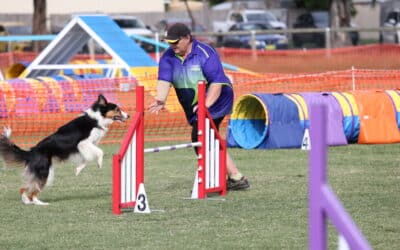
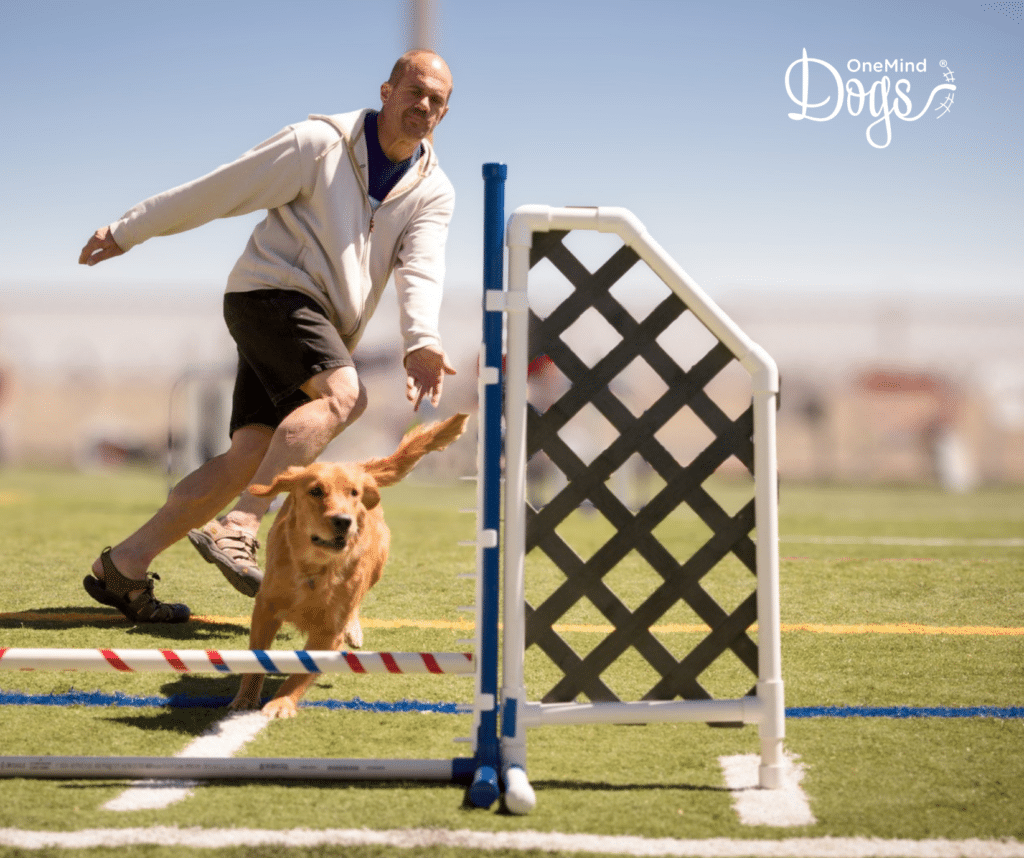
A rear cross happens when a handler crosses behind their dog to signal a change of direction. In theory, it’s simple. In practice, it’s one of the easiest places for a handler’s body to say one thing while their feet do another.
Here’s how it usually goes wrong:
- The handler rotates their shoulders confidently toward the new direction
- They say “left” clearly and with intent
- But their feet never actually cross the dog’s line before takeoff
From the dog’s side of this, the picture looks completely different. Your shoulders turned, but you’re still standing on the same side you were a second ago. Your movement and position, the single most reliable pieces of information your dog has, told them nothing changed. So the dog keeps going straight or spins towards you. Not because they ignored you. Because the strongest signal available to them, your position relative to their line, didn’t match what your voice said.
This is why so many handlers feel baffled by inconsistent rear crosses. It doesn’t feel like a mistake from the handler’s side, the intention was clearly communicated, at least in the handler’s mind. But intention and information are two different things, and dogs respond to information.
So what actually fixes this?
The fix isn’t to stop using verbal cues. Your voice is genuinely one of the seven elements dogs read, and it absolutely matters, especially once your dog trusts it. The fix is making sure your body agrees with your voice, so your dog is getting one clear, unified signal instead of several conflicting ones layered on top of each other.
In practice, this usually means:
- Actually completing the physical cross before the dog takes off, not after
- Letting your feet, chest, and eyes agree with what your voice is saying
- Noticing when you’re relying on a verbal cue to “cover for” a late or incomplete physical one
Once a handler starts paying attention to this, the change is often immediate. Dogs don’t need dozens of repetitions to understand a clearer picture, they just need the picture to actually be clear.
Start seeing your runs through your dog’s eyes
The good news is that once you know what to look for, this becomes one of the fastest things to improve in your handling. You don’t need to overhaul your whole system, you need to notice where your body and voice are disagreeing, and start closing that gap.
If you want a structured, guided way to start doing exactly that, our free ten-day Dog’s Perspective Challenge walks you through it one small daily exercise at a time, so you can see, clip by clip, how your dog experiences your handling and start giving them the clarity they need to commit with confidence.
Your dog isn’t getting it wrong. They’re just responding, perfectly logically, to what you’re actually showing them.