If you’ve started spending time around the agility scene, you may have come across the term “rear cross” and felt that small flicker of overwhelm. Another technique to learn, another thing you’re supposed to already understand. OneMind Dogs Instructor Lee Elgie wrote down some tips to help make it easier for you to understand the rear cross, why it works, and why your dog is probably more ready for it than you think.
The basic idea
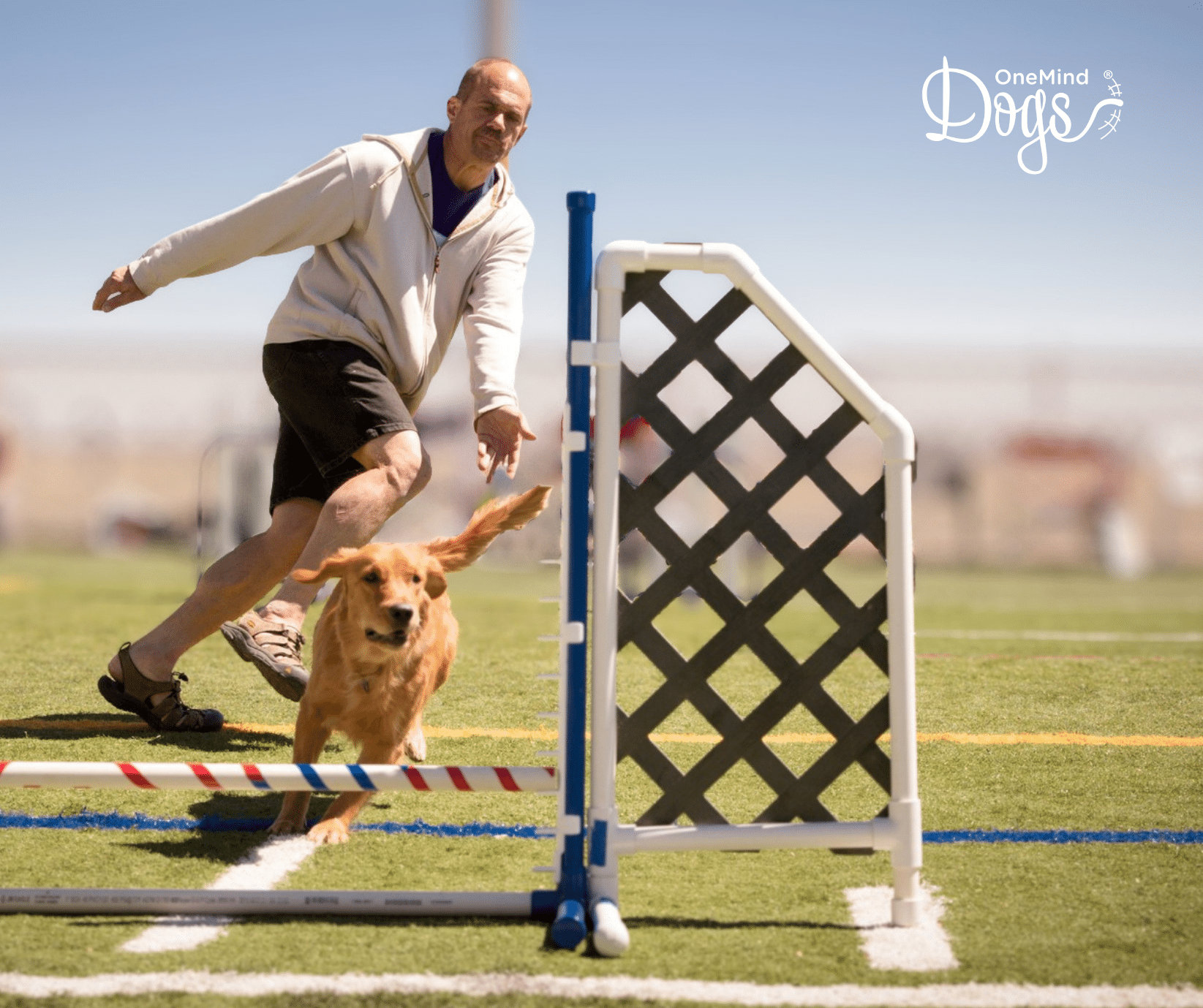
A rear cross is a handling move you use when you end up behind your dog in the sequence. Instead of getting ahead of your dog to cue a turn the way you might with a front cross, you let your dog drive forward and you cross their path from behind, signalling the turn that way instead.
Rear Cross is useful because in full courses, you can’t always be ahead of your dog. Sometimes (most of the time, actually), your dog is just faster than you and trying to get ahead to squeeze in a blind or front cross means getting in your dog’s way or running yourself into the ground. A rear cross lets you handle a turn even when you’re a step or two (or ten) behind.
Why your dog can read this so well
Dogs have excellent peripheral vision, and they’re paying attention to you even when their eyes are pointed at the next obstacle. So when you cross behind your dog, they pick up on that. It’s the same principle behind everything in this method: your dog already knows how to read your body language, often more clearly than they read words. A rear cross is really just one more example of how much information your dog already gets from where you are and which way you’re moving, before you say a thing.
The piece that matters most: commitment
A rear cross only works cleanly once your dog is actually committed to the obstacle. That means their eyes have turned toward it and their body is moving toward it with intent. This is the part that handlers often struggle with. If you cross too early, before your dog has locked onto the jump, the timing falls apart, and your dog won’t have the clear information they need, which usually causes them to refuse the jump altogether. Cross too late, and your dog will turn the wrong way, or knock the bar trying to change direction in mid-air.
A useful way to watch for this is to stop staring at the obstacle and instead watch your dog’s head and ears. When their head turns to the jump and their ears lower, that’s the best way to tell the exact moment commitment happens.
How close you are changes how tight the turn is
One cool thing about rear crosses: where you actually perform the rear cross changes how your dog turns! The closer to the jump you make your move, the tighter the turn will be, because your dog can see that rhythm change more clearly when they’re still collecting their stride and they aim their movement after the jump to the place they saw you last. If you’re further back and your dog has already opened up into full extension, they’re less likely to notice the change in time, and you’ll get a wider turn instead.
This isn’t a flaw, it’s actually a tool. Once you understand it, you can choose where to perform your rear cross based on how tight or wide you need that turn to be for whatever comes next in the sequence.
What this means for your body language
During a rear cross, your chest should stay pointed at the obstacle while you’re committing your dog to it, then move to point along the new line once the turn is happening. Your arms stay low through the cross itself, and you can swap them once your dog has landed and changed sides. Some handlers find it helpful to picture following the dog’s tail through the turn, since that gives you a sense of supporting the movement all the way through to landing rather than stopping your own motion the moment the cross happens.
If your dog needs a bit of extra encouragement to drive ahead of you confidently, a verbal like “go” can support that. It’s not doing the work of the cross itself, it’s just giving your dog a bit of extra confidence to commit forward while you’re behind them.
Why rear cross feels tricky at first
Most of the difficulty with a rear cross isn’t really about body language. It’s about timing and patience. You have to stay behind your dog while still moving forward with purpose, and that combination feels unnatural until you’ve practised it a few times. Handlers often either freeze in place (which gives the dog nothing to read) or rush the cross before the dog has time to commit (which confuses the dog). Once you’ve felt the timing click even once, it becomes a lot easier to repeat.
Where to go from here
This is one of those techniques that looks complicated from the outside and makes a lot more sense once you can see it broken down step by step, with the body language laid out clearly for both you and your dog. Inside Agility Premium, we walk through the rear cross using all seven handling elements together, with detailed graphics and a teaching progression that builds the skill gradually rather than throwing the whole thing at you at once. And if you can’t make it work, you’ll get a personal coach to review your videos and tell you exactly why.
If you want to get a preview before deciding, our Rear Cross mini course is a good place to start. And if you’re ready to stop wondering which program covers what you actually need, Agility Premium gives you the rear cross and the rest of the handling techniques in one place, built around the same dog’s-eye-view approach, with detailed video coaching to help you apply it with your own dog.
Happy training, The OneMind Dogs Team