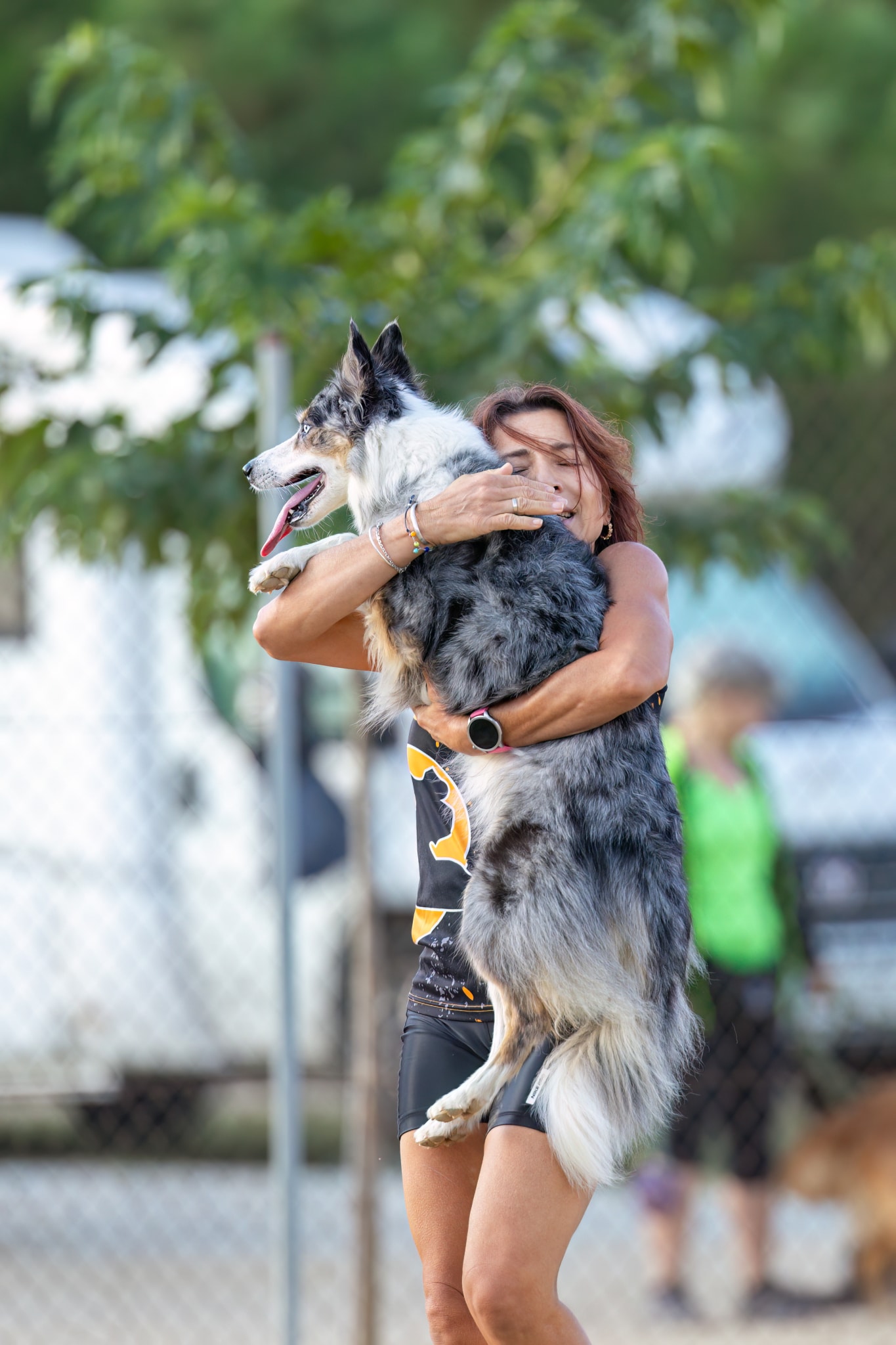
Every agility journey looks different. Some move forward in clear steps. Others take detours, pauses, and unexpected turns. Recently, we asked our community what their dogs have taught them. Francesca, one of our students from Spain, replied in a way that truly moved us. We asked her if she would be happy to share her story, in the hope it might inspire others who find themselves in similar situations.
Francesca’s story with her Border Collie, Asha, is one of those journeys that asks for patience, flexibility, and a deep willingness to listen. This is Francesca’s story, in her own words.
Falling in love without a plan
“Asha arrived in October 2019, shortly before the pandemic changed the world. She was eleven weeks old.
I wanted a Border Collie, but I didn’t yet have a clear plan. What I didn’t expect was to fall in love with a look: intense, serious, far too deep for such a small puppy. It was an immediate, emotional bond rather than a rational choice. We drove 950 km to pick her up from a shepherd in Asturias.”
From the very beginning, this partnership was built on feeling rather than strategy. And that emotional connection would later become both a strength and a challenge.
When sensitivity becomes overwhelming
“In her first months, Asha seemed like a fairly typical puppy: active, sensitive, not particularly food-motivated, and a little shy. Over time, however, a more complex picture emerged. Her sensitivity developed into hyper-reactivity. Fireworks, thunder, rain, engines, sudden noises — every year seemed to add a new trigger. Her nervous system works like a radar that is
always switched on.
This did not affect her only emotionally. It also had a clear impact on her physical well-being: difficulty eating, difficulty relaxing, difficulty recovering.
I vividly remember the summer of 2020. We were in the mountains, among rivers and trails — what I believed would be paradise for a dog became, for her, a constant state of anticipation. In just sixteen days, she lost three and a half kilos. She couldn’t eat in the morning: the anxiety of running through the woods and diving into rivers was stronger than
hunger.”
When training works, until it doesn’t
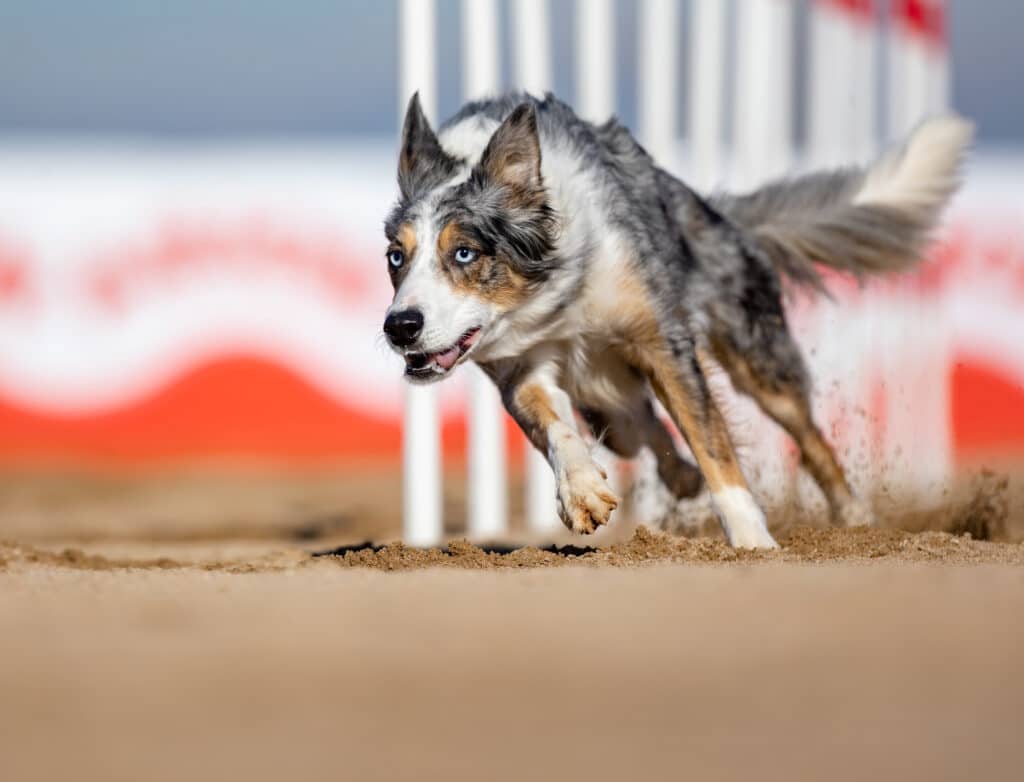
“At home, in a controlled environment, she could work. She accepted rewards, the Treat & Train was helpful, and she showed focus in basic obedience and agility foundations — cones, targets, directional cues, impulse control. Motivation was not the issue. The environment was.
When we moved from the living room to the agility field, everything that worked disappeared.
Noise, dogs, wind, movement — every variable was, and still is, a potential stressor. And above all, the agility field is a drug for her: 100% focus on obstacles. Tunnels, in particular, become her flock. Even today, she often chooses one tunnel on course, and that becomes the “sheep” she feels compelled to herd.
We spent a long time working on handler focus, until she finally began to accept playing with me on the field. After the COVID lockdown, this resulted in almost a full year in which we went to the agility field only to play — deliberately ignoring the obstacles altogether. Even today, she will occasionally (perhaps just to please me) take a small food reward during training. Teaching contact zones, as you can imagine, has been pure madness.”
This phase reflects something many teams experience but rarely talk about: knowing how to train, but realising that applying it requires far more creativity and patience than expected.
Progress that comes at a cost
“Despite a slow, messy path full of stops and restarts, in 2025 we reached something I never thought possible: the highest competition level in Spain, Grade 3. For me, this was a huge achievement — but also a heavy one. Every step forward required careful management, emotional regulation, and constant observation. Often, the feeling was — and still is — that we are working right at the edge of our limits as a team.
Then Lady GoDiva arrived — another Border Collie, with a completely different type of energy.
Her arrival deeply affected Asha’s balance. A dog who was already sensitive felt destabilised, and this had a significant impact on our agility performance: regressions, tension at the start line, and difficulty maintaining focus.”
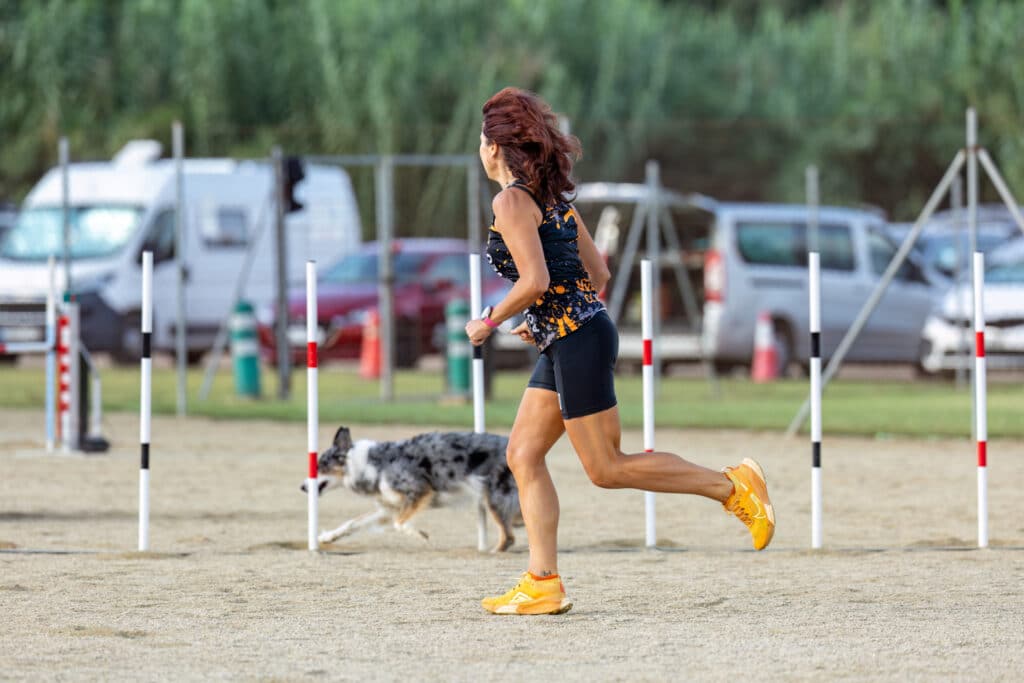
Francesca’s journey
“This was a frustrating period, and this is where the other part of the story comes in: me.
My personality is not an easy one. I am competitive, intense, and strongly result-oriented. When I work, I want to see results. With Asha, this has almost always been impossible — not due to lack of effort, but because progress with her does not follow a logical or predictable pattern.
A sentence said by an agility friend, Nikol, stayed with me:
“Remember that your results in the ring do not define you as a person.”
For me, this was a turning point. Working hard without seeing visible results hurts me deeply. And Asha, in her own way, forced me to separate the value of results from the value of the relationship. Every dog has limits, every handler has limits, and agility — because of the intensity of the connection — inevitably exposes the limits of the team.
Many times, I was close to giving up. What we needed was a shift in perspective.
I couldn’t ask Asha to adapt to agility. I had to adapt agility to Asha — and soften my own mindset.”
Structure, principles, and flexibility
“Working with another dog, GoDiva, has shown me what it feels like when training and response align more easily. And through that contrast, I have come to understand just how demanding — and how valuable — the journey with Asha has been.
Today, I strongly believe in structured systems and clear principles — and OneMind Dogs explains them exceptionally well: primary cues, body language, clarity, consistency, line awareness, and environmental management. But I also believe that technique must always be adapted to the individual dog and to the team. There is no single recipe that works for
everyone.”
This balance between structure and adaptation is at the heart of sustainable agility training.
What Asha has taught me
“Asha has taught me flexibility, humility, and the importance of observation and adaptation. She has taught me that results do not define value. And that some dogs don’t teach you how to win — they teach you how to understand.
I measure our future not in titles, but in our ability to accept our limits, to build on what works, and to continue developing a shared language that belongs only to us.
Because Asha hasn’t just taught me agility. She has taught me who I am, who I can become, and why loving this sensitive, challenging dog — and this sport — has shaped me far beyond the ring.
I would also like to take this opportunity to thank everyone who has helped us along the way, and especially my husband, Toni — our greatest supporter — who has so often put the pieces back together in this complex relationship between three: Asha, agility, and me.”
Your journey will look different too
Francesca’s story is a powerful reminder that agility is not about forcing dogs into a system. It is about learning principles, then shaping them to fit the dog in front of you, the environment you train in, and the team you are building together. Developing your own signature within our guiding principles is a key concept of learning with the OneMind Dogs method.
If you are feeling a bit stuck in your agility journey, wondering why progress feels uneven, you are not alone.
👉 Start your own agility journey with OneMind Dogs, and learn how to train with clarity, structure, and the flexibility your dog needs to thrive.