When you’re first starting out in Agility, it can easily feel overwhelming. There are courses to memorise, lines to plan, and timing to perfect. When something goes wrong, it is easy to assume the dog needs more training or more skills. But after observing hundreds of dogs when we founded the OneMind dogs method, we realised something important. Most mistakes in agility are not about lack of skill. They are about unclear communication and a lack of understanding the dog’s perspective.
At the heart of OneMind Dogs agility handling are the 7 handling elements. These elements form the complete language between handler and dog. When they work together, agility feels smooth and logical. When they conflict, confusion appears.
Understanding these elements changes how you see agility. It shifts your focus from controlling your dog to communicating clearly with them and running as a seamless team.
What are the 7 handling elements in OneMind Dogs agility?
The OneMind Dogs method is built on seven simple elements:
- Your movement
- Your position in relation to the dog and obstacles
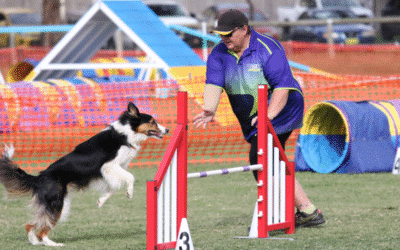
- Your connection through your eyes
- The direction of your chest, often called the “laser point”
- The direction of your feet
- Your hand signals
- Your verbal commands
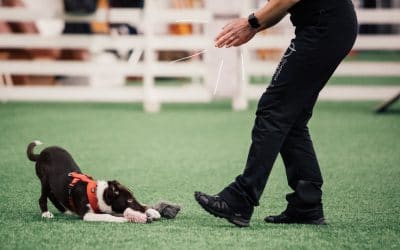
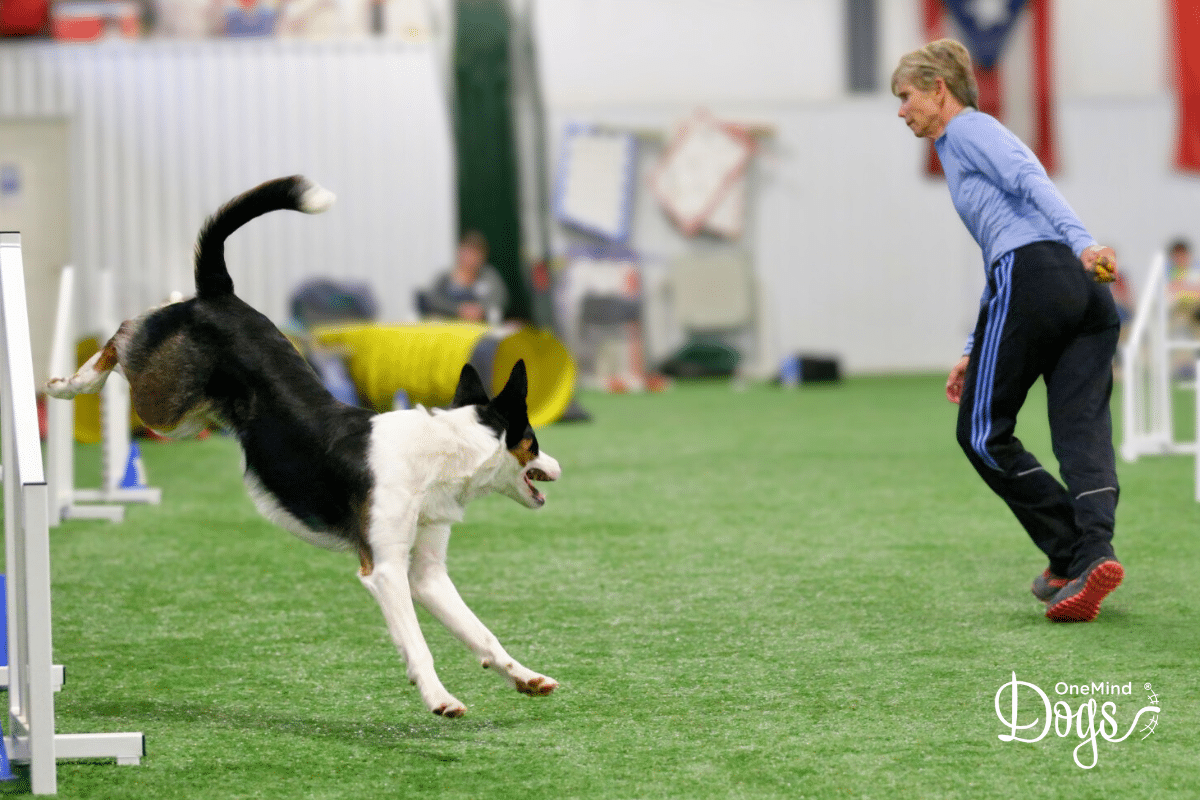
These are mostly based on natural, non-verbal reactions. That is not accidental. Dogs naturally read body language first. Words are a second language to them. Think about your dog as a puppy. When you ran off, chances are that they chased you, right? When you stopped running, they likely stopped too, to see what you’re going to do next. This natural reaction to human movement is one of the most powerful handling elements we can utilise in agility.
Every OneMind Dogs handling technique is a specific combination of these seven elements. When combined correctly, they clearly support your dog’s line and decision making on course. We’ve just published a new “Dog’s Perspective Agility Challenge” to help you experience your dog’s reactions to the 7 handling elements in a clear and simple way. It’s a free 10-day challenge with minimal equipment, why not give it a try?
Why dogs read body language before words
Dogs are experts at reading physical cues. In daily life, they respond to posture, direction, and even your mood long before they respond to spoken language. In agility, especially at speed and under arousal, this instinct becomes even stronger.
If your movement says “go forward” but your voice says “turn,” your dog will usually follow your movement. If your chest rotates one way and your hand points another, your dog must choose which signal to trust.
In some cases, handlers train independent verbal cues with a lot of repetition and proofing, so they can trust the dog will respond. Whilst this is a valid training option, using your body language to support the verbal cue is always easier and clearer for the dog. And if we can make things easier for our dogs, why wouldn’t we?
Movement, position, your eyes and your chest naturally speak louder than verbal commands. That is why understanding the 7 handling elements in OneMind Dogs agility is so powerful. You are not teaching your dog a new language. You are learning to use the one they already understand.
Learn more about understanding your dog’s perspective in our method course: It’s all about the dog’s perspective.
The problem with mixed signals in agility
One of the biggest causes of frustration for dogs in agility is conflicting information.
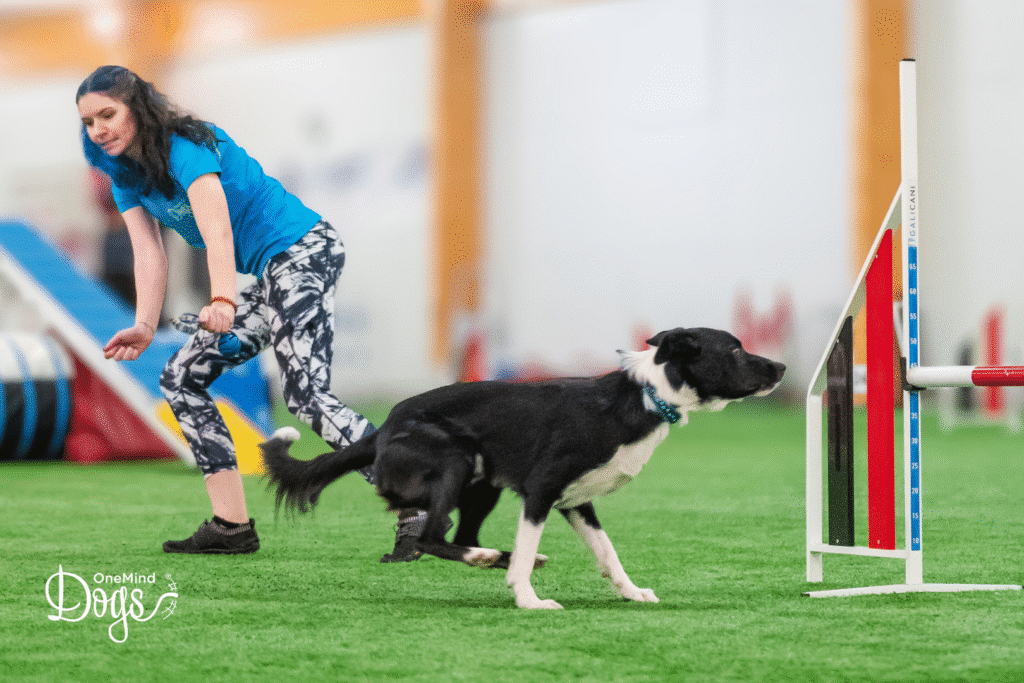
A handler might clearly say “tunnel” and point toward it. But if they start moving sideways down the next line, or if their chest is already turned toward a jump, the dog receives multiple instructions at once. If the dog then refuses the tunnel and the handler gets frustrated, it can cause a real breakdown in the connection between handler and dog.
From the handler’s perspective, the cue felt obvious. From the dog’s perspective, it was unclear.
A helpful comparison is driving in a new city. You are watching traffic, listening to your GPS, and scanning road signs. If the GPS says turn right but the sign suggests straight ahead, you hesitate. You might make the wrong turn, not because you were careless, but because the information conflicted.
The same thing happens in agility. Dogs do not ignore us on purpose. They are trying to interpret all the signals we give them. When those signals do not align, mistakes happen.
Why alignment creates clarity and confidence
At OneMind Dogs, we emphasise one key principle: all handling elements should support the same message.
When your movement, position, eyes, chest, feet, hands, and voice all indicate the same obstacle and line, your dog does not need to guess. The picture is clear and your dog can proceed with confidence.
Clarity builds confidence. A confident dog commits earlier and runs with better flow. They stop scanning the environment for extra information because they trust what you are communicating.
This is especially important in modern agility, where courses are more technical than ever. Tight turns, discriminations, and complex sequences demand precision. Precision does not come from louder cues or more repetitions. It comes from consistent, aligned communication.
How the 7 handling elements support modern techniques
OneMind Dogs teaches more than 30 handling techniques. That may sound complex at first. But every technique is built from the same seven elements, done the same way every time. And handlers will choose which techniques suit their team and create their own handling toolbox based on that.
Once you understand how these elements influence your dog’s line, techniques start to make sense. They are not random moves to memorise. They are logical combinations of movement, position, and direction. And when they make sense, they feel second nature. Handling will become automated, allowing you to focus on your dog and the course at hand.
In fact, most dogs already understand many of these patterns naturally. They follow movement. They respond to position. They notice the direction of your chest and feet.
Often, it is the handler who needs more training than the dog.
When you refine how you combine the 7 handling elements, you reduce confusion without increasing pressure. You guide rather than control.
A shift in mindset: from commands to communication
Understanding the 7 handling elements in OneMind Dogs agility changes the questions you ask, and the way your approach mistakes.
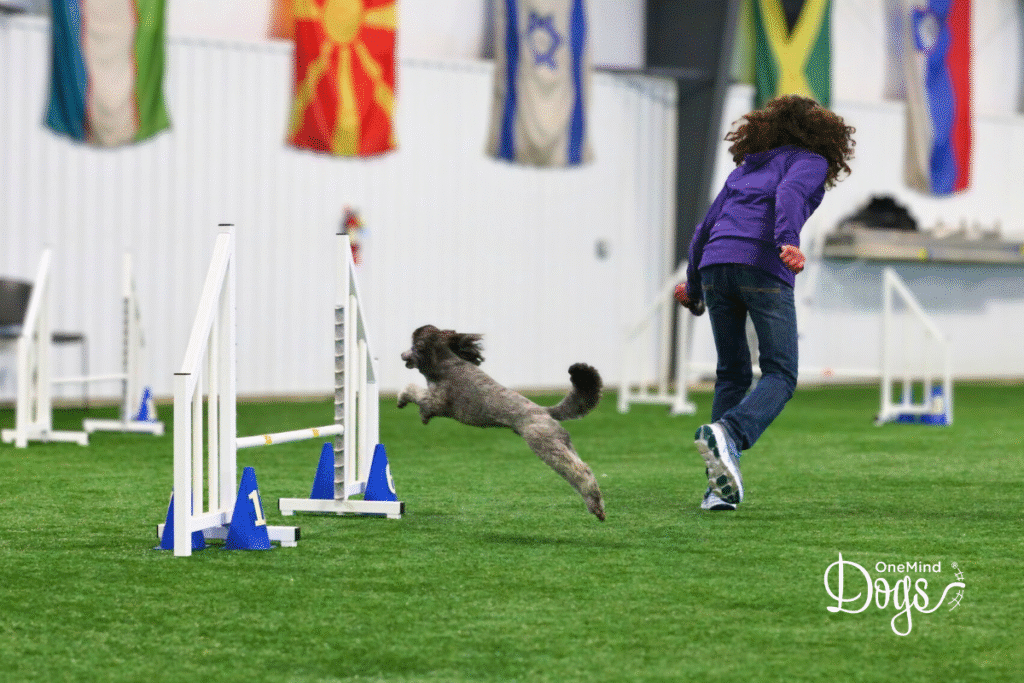
Instead of asking, “Why didn’t my dog listen?” you begin asking, “What did my body communicate?”, “what did my dog understand in this situation”, “Which element do I need to adjust to make it clear what I want the dog to do”.
This shift removes blame from the dog and places responsibility on clarity. Dogs are always responding to something. If the response is not what you expected, the message may not have been clear.
When you improve clarity, behaviour improves naturally. Dogs LOVE clarity and predictability. They thrive on it. Many of our students mention that their dog’s confidence and enjoyment in agility improved ten fold once they understood the 7 elements and they started handling in a clear, predictable way for the dog. Shifting the blame for mistakes away from the dog, and instead focusing on mistakes as information and an opportunity for learning, made a huge improvement in their connection and brought the fun back to agility, as it should be!
Why the 7 handling elements matter for real teamwork
Agility is meant to be a team sport. Flow, seamless connection, and joy come from understanding each other.
The beauty of OneMind Dogs agility lies in its simplicity. Rather than memorising countless unrelated cues and techniques, you learn one consistent language built from seven elements. Movement, position, eyes, chest, feet, hands, and voice form the structure. Everything else is a variation of those elements in action.
When these elements work together, the course stops feeling chaotic. It becomes a conversation.
And when that conversation is clear, your dog can run with confidence and trust. That is why the 7 handling elements matter. They are not just part of the method. They are the foundation of clear communication, confident performance, and true teamwork in OneMind Dogs agility.
Start the free “Dog’s Perspective Agility Challenge” today and get 10 fun exercises to do with your dog, to help you see the 7 elements in action!